Commercial Solar Financing and Tax Incentives in Calgary (2026 Guide)

Solar Guides

On this pageWhat Financing and Tax Incentives Can a Calgary Business Use for Solar?
As of November 10, 2026, a Calgary business has three main tools for paying for a solar project: the City's Commercial Clean Energy Improvement Program (CEIP), which is financing you repay as a separate charge on your property tax bill, and two federal tax measures, a tax credit and a faster write-off. Alberta's micro-generation rules then decide what your exported power is worth. Alberta does not offer a province-wide solar rebate.
At a Glance, as of November 10, 2026
- Calgary's Commercial CEIP opens to applications on November 17, 2026 at 9:00 a.m.
- CEIP can finance up to 100% of eligible project costs, to a maximum of $1 million per property, at an estimated 6.00% to 6.10% for up to 20 years
- The federal Clean Technology Investment Tax Credit is refundable and worth up to 30% of eligible solar costs for taxable Canadian corporations
- Solar equipment bought after 2024 and running before 2030 qualifies for immediate expensing, a full write-off in the first year
- Systems under 150 kW earn bill credits at your retail energy rate for power sent to the grid
What Financing and Tax Incentives Can a Calgary Business Use for Solar?
Four sets of rules shape the cost of commercial solar in Calgary: one financing program, two federal tax measures, and the provincial rules that value the power you export. They work in different ways and have different owners, so it helps to see them side by side.
| Program | Who can use it | Key terms (as of November 10, 2026) |
|---|---|---|
| Calgary Commercial CEIP (financing repaid on your property tax bill) | Properties labelled non-residential on their Calgary tax statement | Up to 100% of eligible costs, max $1 million, estimated 6.00% to 6.10%, up to 20 years. Opens November 17, 2026 |
| Clean Technology Investment Tax Credit (refundable federal tax credit) | Taxable Canadian corporations and certain real estate investment trusts | Up to 30% of eligible costs for equipment acquired and running by the end of 2033 |
| Immediate expensing, Class 43.1 (faster federal tax write-off) | Businesses claiming capital cost allowance on solar equipment | Full first-year write-off for equipment acquired after 2024 and running before 2030 |
| Alberta micro-generation (bill credits for power you export) | Grid-connected systems sized for the site's own use | Under 150 kW: retail energy rate. 150 kW to 5 MW: hourly wholesale price |
The rest of this guide explains each one, who qualifies, and the order to do things in. Program terms change, so check the official sources listed at the end before you commit.
What Is Calgary's Commercial CEIP?
The Commercial Clean Energy Improvement Program is a financing option for energy upgrades on non-residential properties in Calgary. It is an alternative to traditional financing, not a rebate and not a free government program. What you borrow is repaid as a separate charge on the property's tax bill, and the program is administered by Alberta Municipalities on behalf of the City.
Alberta Municipalities lists solar PV and battery storage paired with solar as eligible commercial upgrades. Not every upgrade is eligible, so confirm each part of your project against the program's eligible upgrades list before you apply.
| CEIP term | Calgary Commercial CEIP (as of November 10, 2026) |
|---|---|
| Next intake | November 17, 2026 at 9:00 a.m. |
| Amount | Up to 100% of eligible project costs, to a maximum of $1 million per property |
| Interest rate | Estimated 6.00% to 6.10%, fixed when you sign your agreement |
| Term | Up to 20 years, or the useful life of the upgrade if shorter |
| Minimum project | $10,000 in total capital costs |
| Program administration fee | None in Calgary's commercial program |
| Program funding | Up to $10 million in total for this program |
Two details are easy to miss. First, the $1 million is a ceiling, not a promise: the yearly CEIP charge cannot exceed the property's yearly tax levy, so the real maximum for some buildings is lower. Second, the intake is a funded round, so financing is not guaranteed even for an eligible property.
Does My Building Qualify for Commercial CEIP?
Eligibility starts with how the City classifies your property. It must be labelled "non-residential" on its Calgary property tax statement. New builds and properties labelled industrial or farmland are not eligible. The City says some tax-exempt properties may qualify and asks owners to contact it to check.
What the City Requires
- Property taxes are paid, with no arrears now or in the past five years and no late payments
- No foreclosure or bankruptcy, and payments on debt secured by the property are current
- Debt secured by the property does not exceed its assessed value
- The property is insured for its full value, with at least $1 million in liability coverage
- You are approved and have signed the agreement before any work begins
That last point matters most. Costs incurred before approval cannot be financed, and the City is clear that projects started before approval do not qualify. Do not sign an installation contract that starts work before your CEIP approval comes through.
How Does the Commercial CEIP Application Work?
The City lays out the process in order. Only contractors listed as CEIP Qualified Contractors in the Alberta Municipalities directory can do work financed through the program. The City's page lists an energy audit or feasibility study as a general requirement, while the program terms (last updated March 24, 2026) exempt projects where solar PV is the only upgrade, so confirm what your project needs with Alberta Municipalities.
| Step | What happens |
|---|---|
| 1. Pre-qualification | You confirm the property meets the City's eligibility and financial conditions |
| 2. Energy study | Efficiency upgrades need an ASHRAE Level II energy audit (a detailed building energy audit), and renewable upgrades other than solar PV need a feasibility study, signed by a qualified professional who is independent of the application. Under Calgary's terms and conditions, a project where solar PV is the only upgrade needs neither |
| 2b. Benchmarking | Every project enters its last two years of energy data in BenchmarkYYC, the City's building energy benchmarking program, before the project application |
| 3. Project application | You apply to Alberta Municipalities with the planned upgrades and costs |
| 4. Agreements | You sign the financing agreement, which sets your final rate |
| 5. Installation | A CEIP Qualified Contractor completes the work |
| 6. Completion | Completion forms are submitted and the contractor is paid by the program |
| 7. Repayment | The charge is added to your property tax bill |
On timing, the City says upgrades must be completed and reported before its November 15 cutoff to appear on the next year's tax bill, with payments starting June 30. You can repay the full balance at any time without extra fees once the charge is on your tax account, but partial prepayments are not accepted.
What Happens to CEIP Financing If I Sell the Building?
Calgary Commercial CEIP financing is tied to the property, not to you. When you sell, payments may transfer to the new owner, but you may need to pay off the balance to close the sale. The seller must disclose the CEIP agreement to the buyer as part of the sale.
How Does the Clean Technology Investment Tax Credit Work for Solar?
The Clean Technology Investment Tax Credit is a refundable federal credit on the capital cost of eligible clean technology, including solar PV. Refundable means a corporation can receive it even if it owes no tax that year. It is claimed on the corporate tax return (Schedule 75 of the T2).
| When the equipment is acquired and running | Rate if you meet the labour requirements | Rate if you do not |
|---|---|---|
| On or after March 28, 2023, to the end of 2033 | Up to 30% | Up to 20% |
| 2034 | Up to 15% | Up to 5% |
| After 2034 | Not available | Not available |
The labour requirements cover prevailing wages and apprenticeships for workers on the project. If the claimant does not elect to meet them, the rate drops by 10 percentage points. Ask your installer early whether they can document what your accountant will need.
Who can claim it matters. The Canada Revenue Agency lists taxable Canadian corporations and certain real estate investment trusts, including when they are members of a partnership. Sole proprietors and unincorporated partnerships should not plan around this credit. An incorporated farm that is a taxable Canadian corporation falls under the same rules.
Solar Equipment the Credit Covers
- Solar modules, inverters, control and power conditioning equipment
- Racking and mounting, meters, switches and power transformers
- Fixed battery storage charged by your solar system
- New equipment only, located and used in Canada
Natural Resources Canada lists what does not qualify, including the building itself, roof or wall reinforcement, distribution equipment, main electrical transfer switches, and backup generators. Two more rules affect the numbers. Any government or non-government assistance you receive, such as a grant or rebate, reduces the cost the credit is calculated on. And if the equipment is sold, exported or converted to another use within 10 calendar years, some or all of the credit can be clawed back.
Can My Business Write Off Solar Equipment in the First Year?
Yes, for equipment that fits the timing. Bill C-15, the Budget 2025 Implementation Act, No. 1, became law on March 26, 2026. It brought back immediate expensing for clean energy equipment in Class 43.1, which includes solar PV and fixed battery storage. Equipment acquired after 2024 and available for use before 2030 can be written off in full in its first year. Capital cost allowance (CCA) is the tax version of depreciation: the part of an asset's cost a business can deduct each year. The first-year amount then phases down for equipment that starts running from 2030, and the measure ends for equipment running after 2033.
Two points from the official sources help avoid common mistakes. Class 43.2 has expired, so new solar purchases fall under Class 43.1. And some government pages were written before the law passed: the Finance Canada tax expenditures report and the CRA's older accelerated investment incentive page do not reflect Bill C-15, so check the date on anything you read.
You may be able to claim both the clean technology tax credit and the write-off on the same equipment. The credit affects how capital cost allowance is calculated, and no official page we checked spells out the combined effect, so have your accountant model the two together. Ask your accountant how the write-off applies to your business structure.
Timing matters because both federal tax measures look at when the equipment is acquired and when it becomes available for use, and for a project bought now, the available-for-use date is the one that sets the rate. A commercial project that applies when the CEIP intake opens on November 17 is unlikely to be available for use by December 31, 2026, because pre-qualification, the project application and signed agreements all come before work can start. A realistic plan for most businesses is equipment that becomes available for use in 2027, still inside the full first-year write-off window, which runs to the end of 2029.
How Are a Business's Solar Exports Credited in Alberta?
Alberta's micro-generation rules let a business generate its own electricity and earn credits for what it sends to the grid. The system must be sized to meet all or part of the site's own electricity use. It cannot be built mainly to sell power, and its capacity is capped at 5 MW or the rating of the site's electrical service, whichever is lower.
For a small micro-generator, the credit rate is your retail energy rate, agreed with your electricity retailer, not set by the government. Credits usually show up monthly, and your retailer pays out any unused credits once a year.
If your business is on the default Rate of Last Resort with ENMAX in Calgary, that energy rate is 12.06 cents per kWh until December 31, 2026. The rate for the next two years has not been published, and ENMAX says it can change by up to 10%. Under the Rate of Last Resort Regulation, a business site other than a farm can use the default rate only if its forecast yearly use is under 250 MWh.
Export credits offset energy charges, not delivery. The Utilities Consumer Advocate describes delivery costs as largely fixed, and ENMAX notes that you still pay transmission and distribution charges, though they can fall as you draw less from the grid. So a solar system lowers the energy you buy and earns credits on what you export, but it does not erase the delivery part of the bill.
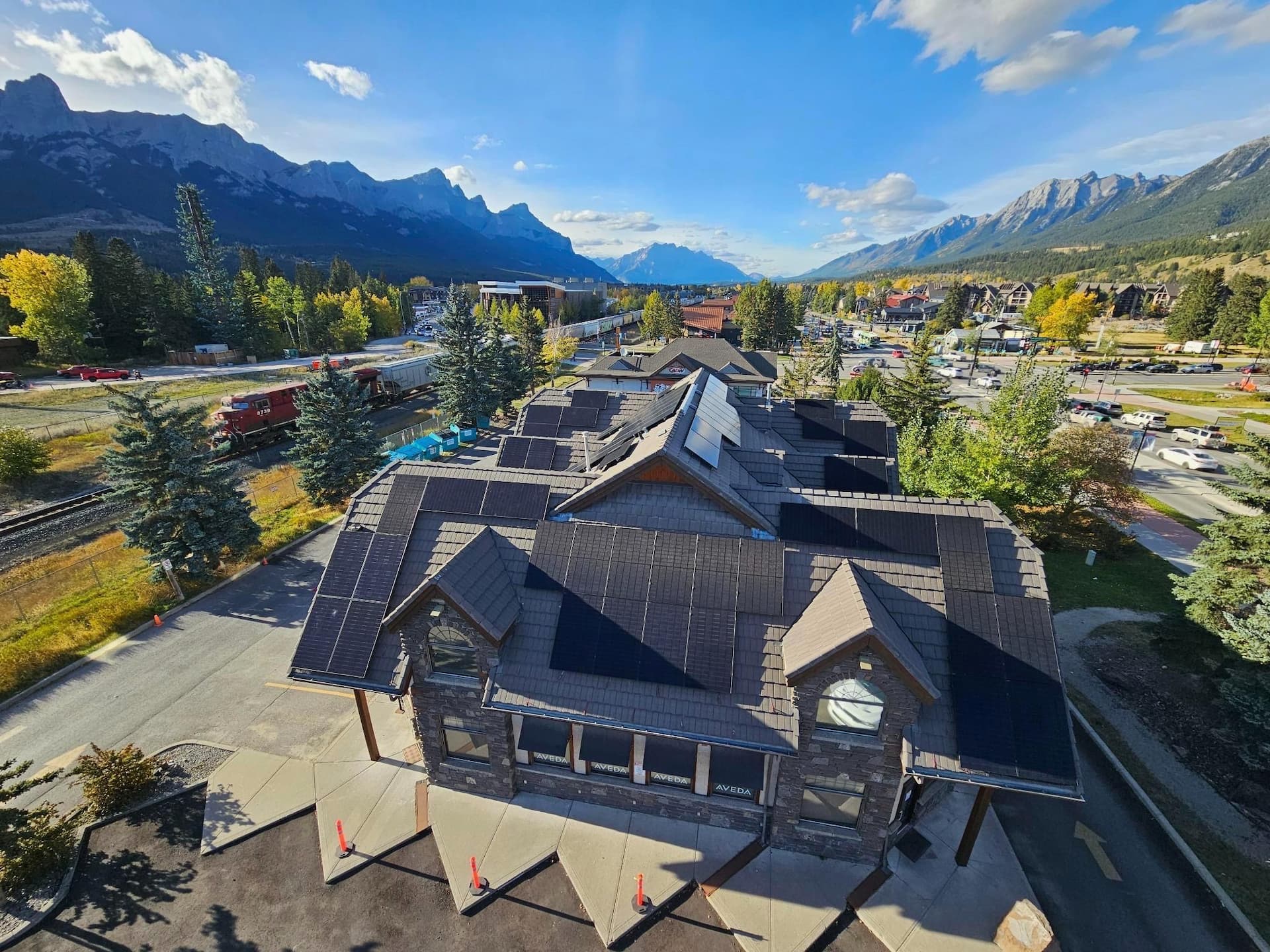
Sizing around 150 kW is where these rules matter most. On our Canmore commercial project, a 32.83 kW system on a four-unit building is modelled to produce 35,344 kWh a year, about 88% of the building's annual use, and it sits comfortably in the small micro-generation tier. Larger buildings need a closer look at whether staying under 150 kW or going above it gives the better result.
See how we sized and installed a 32.83 kW commercial system on a tile roof in downtown Canmore.
Read the Canmore commercial project spotlightHow Is the Clean Technology Tax Credit Calculated? A Worked Example
The numbers below use a round, made-up project cost to show how the clean technology tax credit is calculated. They are not a price estimate for any building.
| Illustrative project | Meets labour requirements | Does not meet them |
|---|---|---|
| Eligible solar equipment cost | $200,000 | $200,000 |
| Credit rate (running by end of 2033) | 30% | 20% |
| Clean technology tax credit | $60,000 | $40,000 |
| With $10,000 from a grant or rebate: amount the credit is calculated on | $190,000 | $190,000 |
| Credit after the grant or rebate | $57,000 | $38,000 |
This example stops at the credit on purpose. How the credit then changes your capital cost allowance, and whether CEIP financing counts as assistance for the credit, are not addressed on any official page we checked. Those are questions for your accountant, using your own tax position.
In What Order Should a Calgary Business Do Things?
The order of events is what you can plan today.
| When | What to do |
|---|---|
| Before you apply | Confirm the property is labelled non-residential. Gather two years of energy data for BenchmarkYYC. Talk to your accountant about the tax credit, the labour requirements and the write-off |
| Pre-qualification | Apply when the intake opens. Get a quote from a CEIP Qualified Contractor. If your project includes efficiency upgrades or renewables other than solar PV, book the required audit or study with an independent qualified professional |
| Approval and agreement | Sign the CEIP agreement before any work starts |
| Permits and connection | Your contractor applies for the City electrical permit, and the project needs a separate interconnection application to ENMAX Power. The City notes that export is restricted in some Calgary networks, so this is worth checking early |
| Installation and start-up | The equipment becomes available for use, the date both tax measures look at. This is a defined tax term, so confirm the date with your accountant |
| Next tax filing | Your accountant prepares the claims. Both measures look at when the equipment was acquired and the year it became available for use |
Which Other Alberta Communities Offer Commercial CEIP?
As of November 10, 2026, Alberta Municipalities lists three commercial CEIP programs: the City of Calgary, the City of Edmonton (open, at 6.0%) and Sturgeon County (open, at 4.45%). Lethbridge, Strathcona County, Canmore, Okotoks, Airdrie and Medicine Hat run CEIP for homes only, so it is not available to businesses there. Status and rates change often, so check the program page before you apply.
Our Alberta Solar Incentive Tracker lists rebates, tax credits and financing programs such as CEIP, with each one's status as of its last check and its official source.
See the Alberta Solar Incentive TrackerWhat Should You Prepare Before You Apply?
Your Commercial Solar Checklist
- Your latest property tax statement, showing the non-residential label
- Twelve months of electricity bills for sizing, and two years of energy data for BenchmarkYYC
- Your corporate structure and fiscal year-end, for your accountant
- A clear answer on whether you will elect to meet the labour requirements for the tax credit
- A site assessment and quote from a CEIP Qualified Contractor, plus an energy audit or feasibility study only if your project goes beyond solar PV
- No signed work order that starts before CEIP approval
CEIP is administered by Alberta Municipalities. Program rules, eligible upgrades and the contractor directory are on the official program site.
Visit myCEIP.ca (opens in a new tab)Nuvo Renewables is a CEIP Qualified Contractor. Own a commercial or multi-tenant building in Calgary? Bring us your electricity bills. We will assess the building in person and walk you through the system size, the permits and the timing.
Explore commercial solar with NuvoSources
Checked November 10, 2026. Program terms change, so confirm each one with the publisher before you rely on it.
| Source | Publisher | Date shown on the page |
|---|---|---|
| Clean Energy Improvement Program (Commercial) | City of Calgary | Updated November 4, 2026 |
| CEIP Commercial Terms and Conditions, Calgary | Alberta Municipalities | Last updated March 24, 2026 |
| CEIP commercial upgrades and program directory | Alberta Municipalities | No date shown |
| About the Clean Technology Investment Tax Credit, and related pages | Canada Revenue Agency | Modified December 22, 2025 to September 11, 2026 |
| Clean Technology ITC: photovoltaic and electrical energy storage equipment | Natural Resources Canada | Modified October 30, 2026 |
| Budget 2025 Implementation Act, No. 1 (S.C. 2026, c. 3) | Justice Canada and Parliament of Canada | Royal Assent March 26, 2026 |
| Micro-generation | Government of Alberta | October 23, 2026 (page metadata) |
| Micro-generation and Rate of Last Resort pages | Utilities Consumer Advocate | 2026 |
| Microgeneration Notice Submission Guideline | Alberta Utilities Commission | 2026 edition |
| Solar questions and answers; Understanding the Rate of Last Resort | ENMAX | No date shown |
| Solar photovoltaic permit requirements | City of Calgary | March 2025 |
| Rate of Last Resort Regulation (office consolidation) | Utilities Consumer Advocate | Current to September 27, 2024 |
| Renewable energy FAQs | Utilities Consumer Advocate | No date shown |
The City of Calgary publishes the Commercial CEIP terms, eligibility rules and application steps.
City of Calgary Commercial CEIP (opens in a new tab)The Canada Revenue Agency explains the Clean Technology Investment Tax Credit, its rates and who can claim it.
CRA: Clean Technology ITC (opens in a new tab)Frequently Asked Questions
Is Calgary's Commercial CEIP a grant or a rebate?
No. CEIP is a financing option, an alternative to traditional financing, and not a free government program. You repay what you borrow, with interest, as a separate charge on your property tax bill. The interest rate is estimated at 6.00% to 6.10% until you sign your agreement.
When does Calgary's Commercial CEIP open for applications?
The City of Calgary says the next intake opens November 17, 2026 at 9:00 a.m. The program has up to $10 million in total funding, so an eligible property is not guaranteed financing. Check the City's page for current status before you apply.
Can a farm use Calgary's Commercial CEIP?
Properties labelled farmland on their tax statement are not eligible for Calgary's Commercial CEIP. An incorporated farm may still be able to claim the federal clean technology tax credit. Our farm solar financing guide covers the other options for farms.
Can a sole proprietor claim the Clean Technology Investment Tax Credit?
The Canada Revenue Agency lists taxable Canadian corporations and certain real estate investment trusts as the eligible claimants, including when they are partnership members. A sole proprietor or unincorporated partnership should not plan around this credit. Ask your accountant about the capital cost allowance instead.
Can I claim both the tax credit and the first-year write-off?
You may be able to claim both on the same solar equipment. The credit affects how capital cost allowance is calculated, and the official pages we checked do not spell out the combined result, so have your accountant model them together for your fiscal year.
Will solar remove the delivery charges from my business's power bill?
No. Export credits offset energy charges. The Utilities Consumer Advocate describes delivery costs as largely fixed, and ENMAX says you still pay transmission and distribution charges, though they can fall as you draw less power from the grid.
Ready to Talk Solar?
Get a free, no-obligation consultation for your property.